Why a dedicated room still beats a very good television
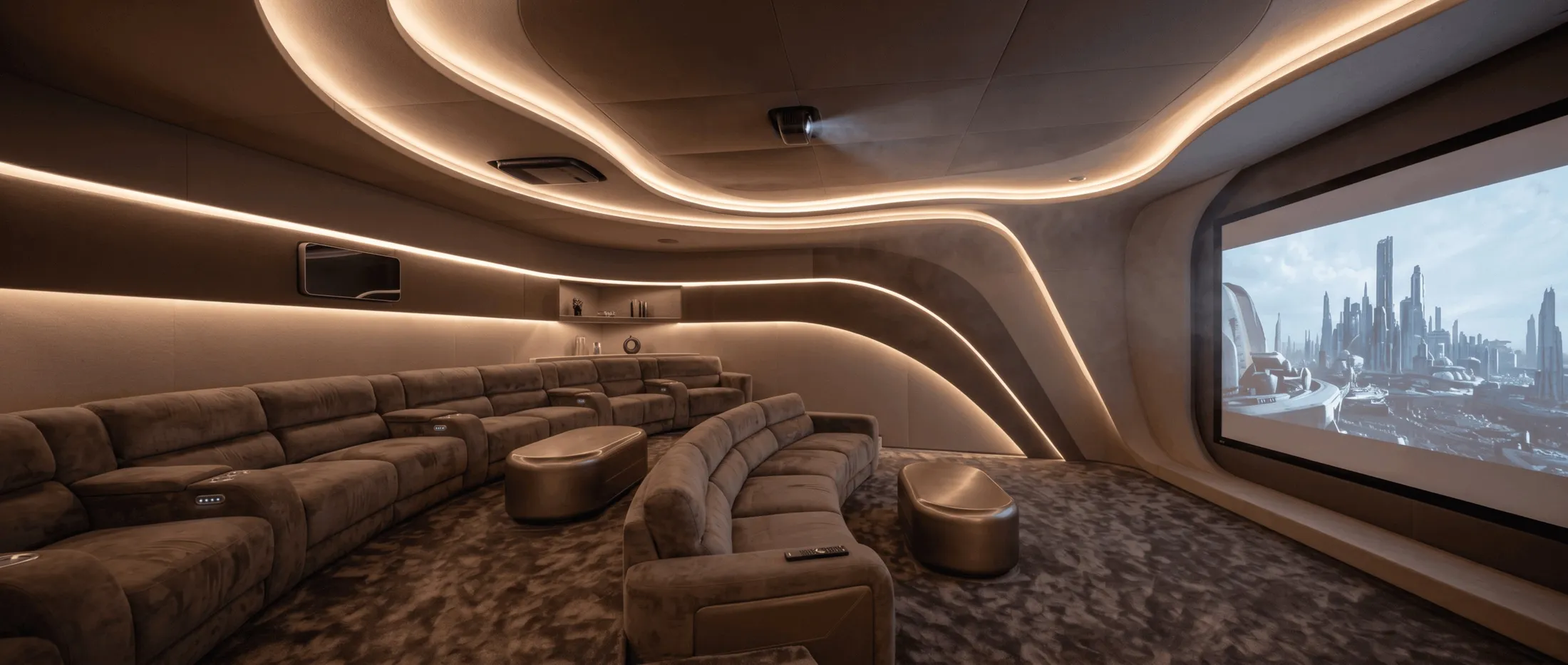
A modern flagship television will out-resolve most projectors, and it will out-contrast every one of them. If the argument for a dedicated cinema rested on the picture alone, the argument would already be over.
It does not rest on the picture. It rests on everything around it.
Light you are not looking at
Contrast is not a property of a screen. It is a relationship between the light coming off the screen and the light already in the room. A panel measured at 1,000,000:1 in a laboratory is measured in a black box. Put it on a wall opposite a window, or under a ceiling light with a warm bounce off a pale plaster wall, and the black floor of that image rises to meet the room. The number survives. The image does not.
A dedicated room removes the competing light rather than fighting it: dark matte surfaces that absorb rather than return, no uncontrolled daylight, and lighting scenes that fall away in steps rather than a single switch. That is why a well-built room with a good projector reads deeper than a better panel in a living room. It is not out-performing the panel. It is removing what the panel is fighting.
Sound you cannot buy
The second half is less negotiable. A loudspeaker in a room is a system with the room, and below roughly 300 Hz the room is the dominant partner. Room modes — the standing waves set up by the distance between parallel surfaces — produce peaks and nulls of 10 dB or more at specific frequencies and specific seats. No amount of amplifier, no upgrade path, and no amount of DSP fully removes a null: you cannot electrically boost energy into a place where the room is cancelling it.
What does work is geometry and absorption, decided before anything is built. Room proportions that spread the modes rather than stacking them. Bass traps with enough depth to be effective at the frequencies that actually matter, which means considerably more depth than a decorative panel. First-reflection points treated so the direct sound arrives before its own copy.
None of that can be retrofitted into a finished room without opening it up again. All of it is nearly free at drawing stage.
The honest version
A very good television in a considered room will beat a poor cinema in a bad one. The question is not screen technology. It is whether anyone was allowed to design the room the screen goes in — and at what point in the build they were asked.
More from the journal.
Notes on rooms, sound, light and the work.
Calibration is where a cinema stops being equipment
Why a dedicated room still beats a very good television
What Dolby Atmos actually requires from a room
Begin a project.
We take on a small number of projects each year. If yours might be one of them, we’d be glad to hear from you.