What Dolby Atmos actually requires from a room
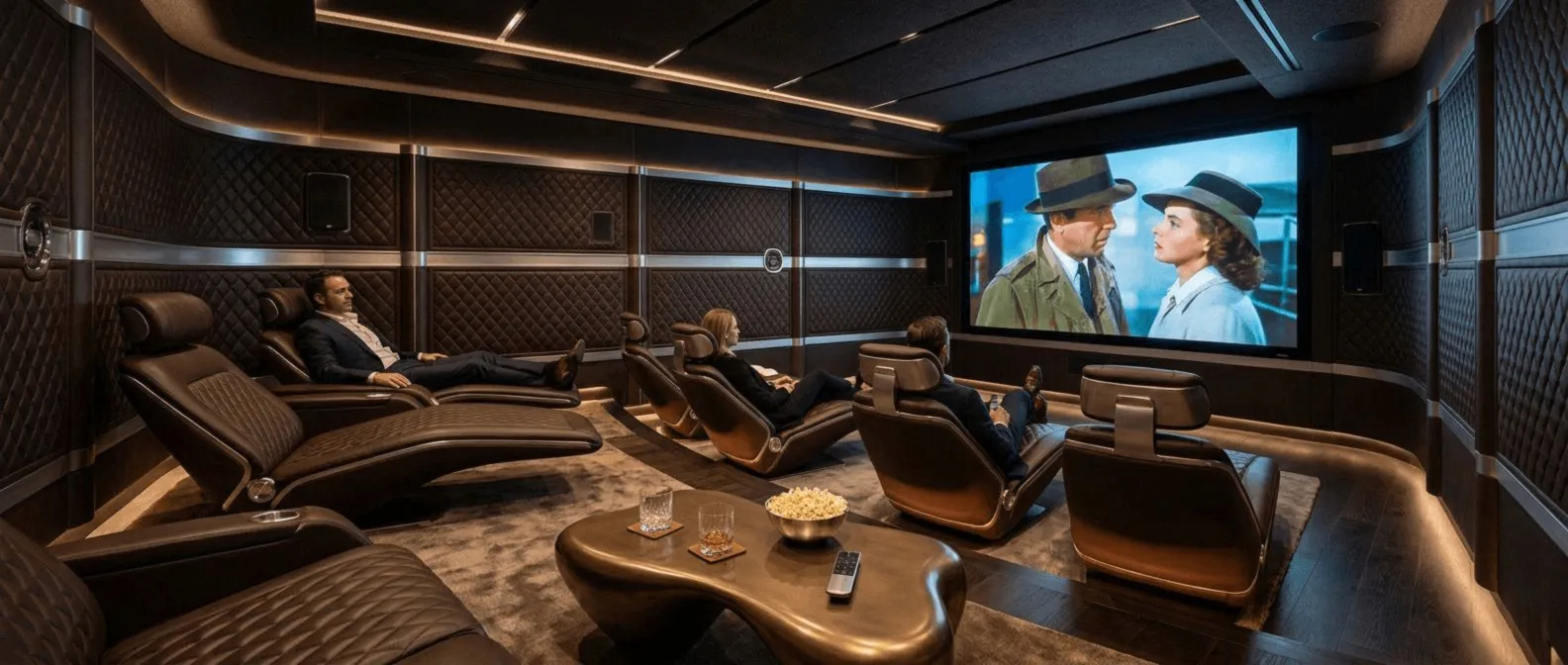
Object-based audio is often sold as a component decision — an Atmos receiver, an Atmos soundbar, an Atmos speaker package. It is more usefully understood as a constraint on the room, because the parts that decide whether it works are the parts that are hardest to change afterwards.
The ceiling is the specification
Overhead channels are the whole point, and they need somewhere to go. Dolby's own guidance places overhead pairs within defined angular windows relative to the primary seat — which turns immediately into questions about joist direction, structural depth, service routing, and how much ceiling height you are willing to give up. A room with 2.4 m of finished height and joists running the wrong way does not have an Atmos problem. It has a construction sequence problem, and it has it in month one.
In-ceiling speakers also need a back box, or they need a void that behaves like one. Firing a driver into an unbounded plenum couples it to the rest of the building, and the neighbouring bedroom hears the helicopter as clearly as the cinema does.
Symmetry beats specification
The single most common Atmos disappointment is not a missing channel. It is an asymmetric one. Human localisation depends on the difference between what the two ears receive, so a left surround at 1.1 m from a hard wall and a right surround at 2.4 m from a curtain will not image, however well matched the drivers are. The room has broken the pair before the amplifier sees it.
This is why the layout is drawn before the loudspeakers are chosen. Where symmetry is impossible — a chimney breast, a structural pier, a door that has to stay — the asymmetry is designed around deliberately, with treatment placed to equalise the reflection pattern rather than the specification sheet.
Bed layer first
An overhead layer sitting on a weak bed layer sounds like effects happening above a film rather than a film happening around you. The seven or nine channels at ear height carry the dialogue, the score and the bulk of the energy; they are where the seating distance, the screen width and the first-reflection treatment all resolve. Get that layer right and four overhead channels feel like a roof. Get it wrong and twelve will not rescue it.
What this means in practice
Atmos is a room specification that happens to be delivered as audio equipment. The decisions that determine whether it works — height, joists, symmetry, back boxes, treatment depth — are all made on drawings. If a project reaches the speaker-selection conversation before anyone has looked at the ceiling build-up, the important decisions have already been made by default.
More from the journal.
Notes on rooms, sound, light and the work.
Calibration is where a cinema stops being equipment
Why a dedicated room still beats a very good television
What Dolby Atmos actually requires from a room
Begin a project.
We take on a small number of projects each year. If yours might be one of them, we’d be glad to hear from you.