Acoustic treatment is not the panels you can see
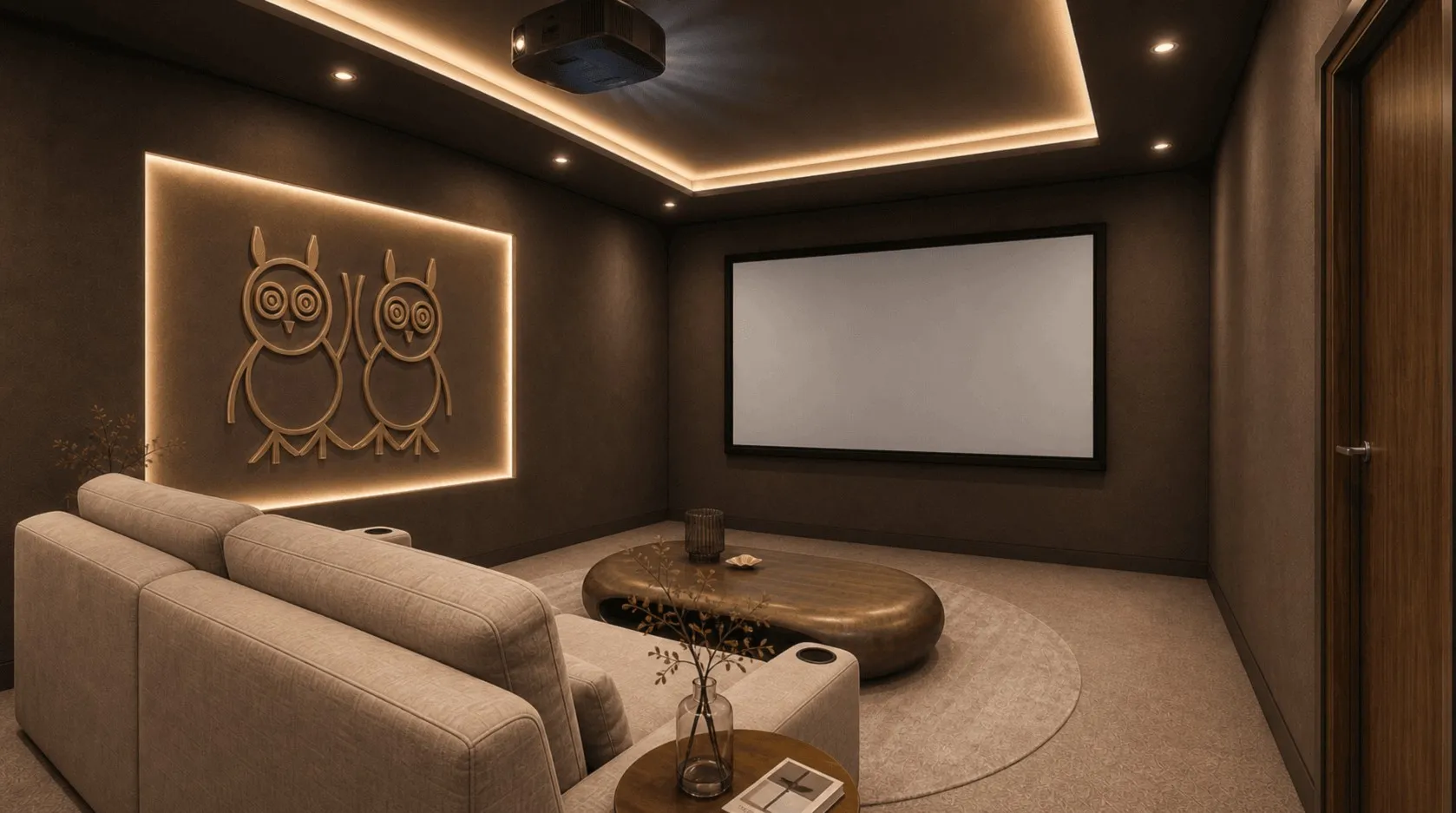
The photograph of a treated room shows fabric. The performance of a treated room is mostly behind it — and mostly decided by depth.
Depth is the specification
A porous absorber works on velocity, and air velocity is at its maximum a quarter-wavelength from a boundary. At 1 kHz that is around 8 cm; at 60 Hz it is around 1.4 m. This is the whole reason a 5 cm decorative panel is effective on speech and effectively transparent to bass, and no amount of covering the walls with more of it changes that.
Controlling the low end therefore means either genuine depth — which has to be found in the build, usually behind a false wall or in a soffit nobody sees — or tuned membrane and Helmholtz devices that trade bandwidth for thickness. Both are structural decisions. Neither is a finish.
Absorption is not the only tool
A room absorbed uniformly across the spectrum is a room that sounds dead and oddly bright at once, because porous material always takes the top octaves first. What a cinema wants is a controlled decay that is roughly even with frequency, arrived at with three tools rather than one: absorption where early reflections would smear the image, diffusion where the room needs to stay alive without returning a distinct copy, and reflection preserved where it does no harm.
The proportion between those three is what makes a room sound composed rather than damped.
Where it has to be decided
All of this competes for the same centimetres as the acoustic isolation, the service voids, the lighting details and the finished dimensions of the room. On a project where treatment is specified after the walls are up, it loses that competition every time, and what remains is the two centimetres you can see.
That is the reason we draw acoustics at the same time as the architecture, and not as a stage that follows it.
More from the journal.
Notes on rooms, sound, light and the work.
Calibration is where a cinema stops being equipment
Why a dedicated room still beats a very good television
What Dolby Atmos actually requires from a room
Begin a project.
We take on a small number of projects each year. If yours might be one of them, we’d be glad to hear from you.